About
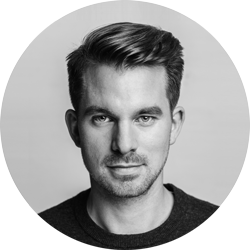
About me, Hubertus
I've been building companies for more than 25 years. If there's one thing this taught me, it's that the interesting part is rarely what you build. It's what building reveals about the world and yourself.
Looking back, the pattern was always the same: identify a market gap or problem, find an innovative technology to solve it, and make something possible that wasn't before. I started programming Assembler and C++ at 14 because I loved the idea that you could create something from nothing and put it into the world. That instinct hasn't changed. The ventures have just gotten more complex.
Here are some lessons I've learned over the years.
I. Understanding people is the real foundation.
Before mymuesli at uni, back in the time when movies lived on DVD, Philipp and I opened one of Germany's first automated video rental stores. I personally knew 1,500 of our 4,000 customers — including what they pretended to rent versus what they actually watched which was sometimes disturbing.
During that time, I learned important lessons about people: who sticks to their promises after a handshake and who tries to knock you over even when you have a detailed contract in place. That kind of intuitive knowledge doesn't come from books and was totally worth the 18 months in this particular industry.
Even earlier, during my time with the paratroopers of the German Bundeswehr, I learned something by negation: I saw how I didn't want an organisation to work. Centralised command, siloed information, zero agency. What I wanted instead: distributed thinking from people who see the relevant part of the picture and make their own decisions fast. I learned to value speed over perfection. And that change is evolution.
These principles became what I aimed to implement into all my teams.
II. Business can create genuine win-win-win outcomes — if you fight for it.
When Philipp, Max and I founded mymuesli in 2007, we wanted to prove something to ourselves: that a business could create value for everyone involved — customers, team, founders, society — simultaneously. We bootstrapped for eight years. Our initial funding was €3,500 pooled between us. What followed was an extremely steep learning curve and a wild rollercoaster — at times with over 800 team members, 50+ of our own stores, active in nine countries. And then COVID turned the world upside down.
We brought mass customisation to the world of fast-moving consumer goods: 566 quadrillion muesli variations, connecting food and e-commerce was a novelty; and being a founder was not cool back then. In 2025, Harvard Business School published a case about it: "Managing Complexity at mymuesli."
But the deeper lesson wasn't about product-market fit. It was about culture. We three co-founders put our friendship as the highest priority. That was the right thing to do, but it sometimes didn't make things easier. And I learned that "culture eats strategy for breakfast" is so much more true than I ever thought it could be. Because culture is what decides how a group of people behave when nobody's watching and there's no playbook.
Mymuesli also taught me the hard lesson:s during COVID, we had to close stores and let go about 500 people. There is no preparation for such founder realities.
III. Alignment is everything — and one degree off at the start becomes an ocean apart for co-founders at the horizon.
After 15 years at mymuesli, I transitioned to the supervisory board and, just three days later, co-founded Project Eaden. The mission was bold: transfer textile fibre technology into food production to create ultra-realistically textured meat from plants — in a world where cattle contribute 6–8% of global CO₂-equivalent emissions. We raised the largest alt-meat seed round in Europe (€10.5M). The first products hit supermarket shelves in May 2024 under the brand Lekka.
What Project Eaden reinforced was that scaling for good can work greatly. But it also taught me that co-founder alignment is even more essential than I believed after mymuesli. If you're just slightly off in the beginning, the gap widens — like two sailing boats leaving the same harbour with a one-degree course difference. At first they're side by side. By the horizon, they can't even see each other. Luckily we managed to navigate this well and professionally, and I am super happy for David and Jan that the products (branded Lekka) fly off the shelves now.
IV. Consumers buy with emotion. For B2B purchases the only emotion is fear.
My most recent venture, RSN8 Labs, grew from a question: what if you could ask your target audience before spending the money? We use AI to simulate audiences and predict the resonance of marketing assets; enabling A/B testing before anything goes live. I co-founded RSN8 with Leonard, whom I'd met eight years earlier at an AI conference where he was the youngest in the room asking the smartest questions. We started self-funded, intentionally small, and agents-first.
Building RSN8 sharpened something I'd sensed at mymuesli but never articulated this clearly: in consumer markets, brand explains roughly 50% of pricing power and people make decisions purely based on emotions. Often, even what they intent to buy is a change of their emotions. In B2B, the buying process is rational, structured, committee-driven — and the only real emotion involved is fear. Fear of making the wrong choice. Once you see this, getting people to buy your product or service needs to be a different game. Still learning a ton here.
V. Brilliant minds who also happen to be great humans actually exist.
In 2023, I met Daniel. In 2025, I became Partner and CMO at EWOR. We support the top 0.1% of early-stage founders — people who want to positively bend the future and have the talent and drive to actually do it. I've been a founder, I've mentored founders, but working with this density of outliers has been a different experience entirely. With every conversation, I regain a little more faith in humanity. I very much needed this, given the last few years of developments in the world.
At EWOR I get to bring everything together: the pattern recognition from 25 years of building, the scars from scaling and from staying small, the lessons from bootstrapping and from raising venture capital, from consumer brands and from tech and AI. What's even better:I didn't have to shed my entrepreneurial spirit to join — quite the opposite.
I've always believed that realising an idea by building something is an act of creation that changes reality. The more it resonates and scales, the more people's lives are touched — hopefully in a positive way. This is contributing to change, and change means evolution.
At the end, isn't that what we're here for?
Awards & Honours
Awards are something one accepts on behalf of the collective. Among the recognitions I'm most grateful for:
- German Marketing Prize (Deutscher Marketingpreis) 2016
- German Founder Prize (Deutscher Gründerpreis) 2013
- Startup of the Year (Startup des Jahres) 2007
Roles & Commitments
Beyond my own ventures, I engage where I believe entrepreneurship can drive meaningful change — particularly at the intersection of sustainability, health, and artificial intelligence. My involvements include:
- Member of the Kuratoriums "German Founder Prize" (since 2022)
- Member of the supervisory board mymuesli AG (since 2022)
- Member of the Advisory Board of &ever | Vertical Farming (2020-2021)
- Member of the Advisory Board of SIRPLUS | food rescue (2019-2022)
- Member of the Jury for the "Top 100 Innovators of the Year" (2014-2021)
- Early supporter of the Entrepreneur's Pledge (since 2014)
My angel investments and mentoring of early-stage founders is now concentrated on EWOR Fellows and their startups. I rarely engage in public speaking opportunities.
Want to get in touch? Happy to connect on LinkedIn :)